Here is a scenario that plays out more often than it should when we talk about Warehouse builder in Newcastle.
A business builds a new warehouse. The structure is solid. The build is clean. The handover goes smoothly. And within six months of moving in, the operation is fighting the building every day.
Forklifts queuing at a loading dock that is too narrow. Racking that cannot be extended because the column grid is in the wrong position. Trucks reversing because the hardstand layout does not allow forward exit.
None of this shows up during construction. It shows up in the first week of full operations.
A warehouse that looks right but operates poorly is more expensive than one that looks ordinary but operates efficiently.
This guide covers the first design decision in every warehouse build: the one that sets the column grid, the eave height, the slab specification, the loading dock configuration, and the hardstand layout.
Get it right, and everything else follows. Get it wrong, and you pay for it daily.
The First Question a Warehouse Builder Should Ask, and Usually Does Not
Most clients come to a warehouse builder with a site and a size in mind. They want X square metres of covered storage. They have a budget in mind.
The first question should not be about size or budget.
It should be: what moves through this warehouse?
- What is the inbound vehicle mix: rigid trucks, semi-trailers, B-doubles, containers?
- What forklift or materials handling equipment will operate inside?
- What is the racking system: standard selective racking, drive-in racking, narrow aisle, automated storage?
- What are the peak throughput periods: single shift, multi-shift, 24/7?
- What is the storage height requirement?
- Will the operation grow in the next five years?
The answers to these questions determine the structural grid, the eave height, the slab specification, the number and type of loading docks, and the hardstand layout. Every warehouse design decision follows from them.
A builder who does not ask these questions is designing a generic box. A builder who does is designing your specific operation.
The questions are clear. The decisions they drive are where the complexity lies, and where most warehouse builds in Newcastle quietly go wrong.
The Four Design Decisions That Define Warehouse Performance
Before we dive into the details, it’s important to understand one thing: a warehouse’s long-term performance is defined almost entirely by four key design decisions.
Each decision may seem minor on its own, but together they determine storage capacity, operational efficiency, and safety.
The Column Grid: Your Racking Layout Starts Here
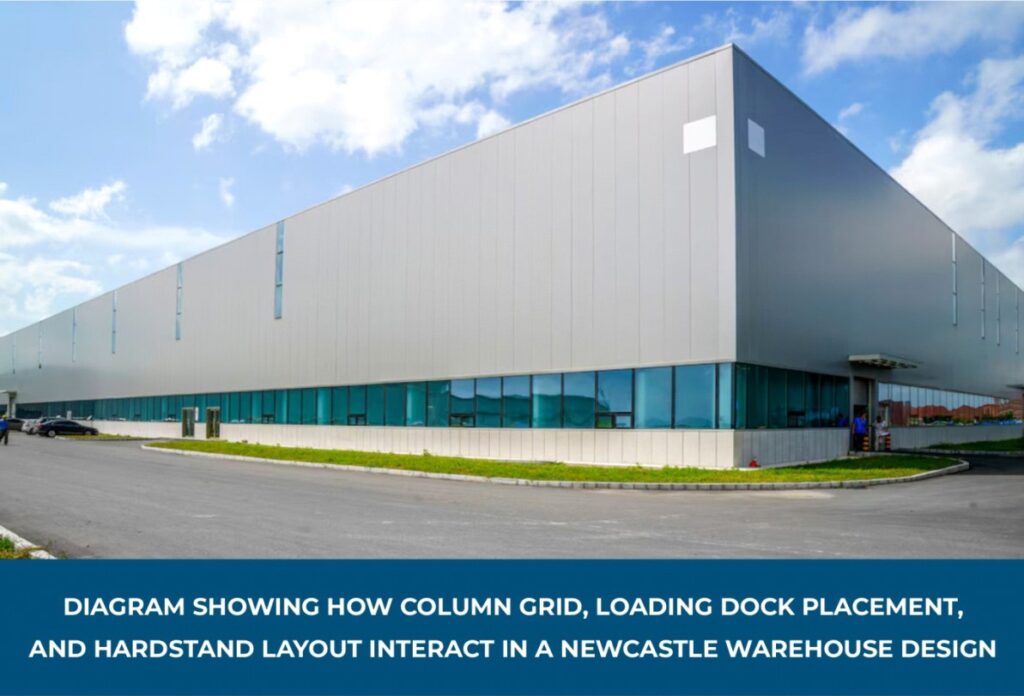
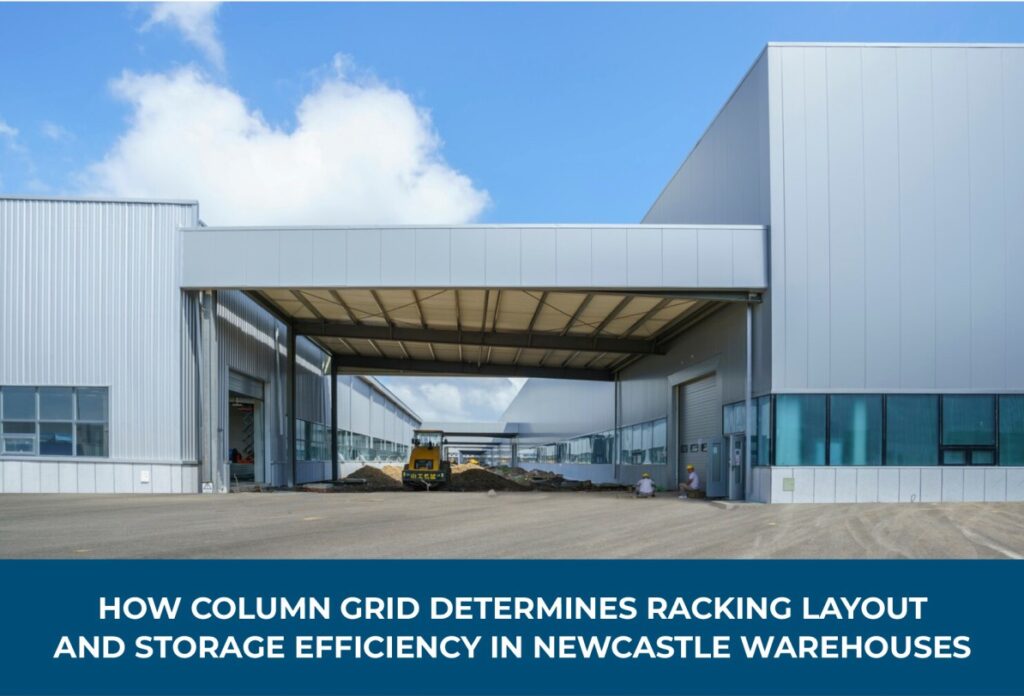
The structural column grid is the spacing between the internal columns that support the roof. For warehouse buildings, this matters enormously because the column grid determines how racking can be laid out.
Standard selective racking (the most common form: rows of pallet storage accessible from aisles on each side) works best with a suitable column grid in the direction perpendicular to the racking rows. Narrower grids force awkward racking layouts with wasted space around columns.
Narrow aisle racking, which uses guided forklifts (VNA equipment: Very Narrow Aisle) to maximise storage density, requires specific grid spacing to function at all. Designing the column grid without reference to the racking layout is working backwards.
A wholesale distribution business in Newcastle specified a warehouse without involving their racking supplier in the design process. When the building was complete and the racking installer arrived to set out the layout, they discovered that the column grid was too narrow for their proposed racking system. The racking had to be redesigned, reducing storage capacity compared to the original plan. The building was correct. The design had missed the requirement.
Eave Height: Getting the Design Wrong Is Permanent
Eave height (the height from the finished floor to the underside of the roof beam at the eave, the lowest point of the usable internal clearance) directly determines how high you can rack, and therefore how much storage volume the building provides.
A common mistake is specifying eave height based on current racking height rather than the maximum racking height the operation could ever use. Adding eave height during construction is straightforward. Adding eave height after the building is complete is effectively impossible.
| Operation Type | Minimum Recommended Eave Height | Notes |
| General storage, standard forklift | as required for the operation | Allows multiple pallet levels of racking |
| High bay distribution, reach truck | as required for the operation | Allows additional pallet levels: significant storage increase |
| Automated storage (ASRS) | as required for the system | Requires specialist structural design |
| Manufacturing with overhead crane | Crane lift height with appropriate clearance | Structural engineer to confirm based on crane specification |
Loading Docks: The Point Where Operations Meet the Building
Loading dock design is the most operationally critical element of a warehouse. The number of docks, their configuration (recessed, flush, or at-grade), their height relative to truck bed heights, and the hardstand layout outside them determine how efficiently goods flow in and out of the building.
The most common loading dock mistake in Newcastle warehouses is under specification: too few docks for the throughput, or docks positioned such that trucks must reverse to exit the site. Both create operational bottlenecks that become visible immediately during busy periods.
For B-double (semi-trailer with two trailers) access, increasingly common in the Hunter Region as distribution operations scale, turning circles and apron dimensions in front of the dock require specific hardstand depths. The apron must provide enough depth for a B-double to dock and exit forward. Many warehouse sites in the Hunter Region cannot accommodate this without careful hardstand design.
The Floor Slab: The Most Critical and Least Discussed Element
The concrete floor slab is arguably the most important element in a warehouse build. It is also the one most commonly underspecified.
Floor loading (the weight per square metre the slab must support, expressed in kPa, or kiloPascals) determines the slab thickness and reinforcement. Standard warehouse slab designs suit many operations. Heavy forklifts, high-density racking, or mobile shelving may require a stronger slab. Surface finish also matters. A standard power-float finish is adequate for many warehouse uses. Operations using VNA forklift equipment require a specialist superflat floor, which costs more to pour and requires specialist contractors, but is essential for safe operation.
A cold storage and logistics operator in the Hunter Valley specified a standard power-float slab. During commissioning of the refrigeration plant, it became clear that the floor heating system required to prevent ground freezing under the cold store had not been specified or installed. The slab had to be core-drilled, the heating system retrofitted, and a portion of the slab replaced. Specifying this during construction would have avoided a major retrofit cost and extended operational disruption.
Why Newcastle Warehouse Projects Need Local Knowledge
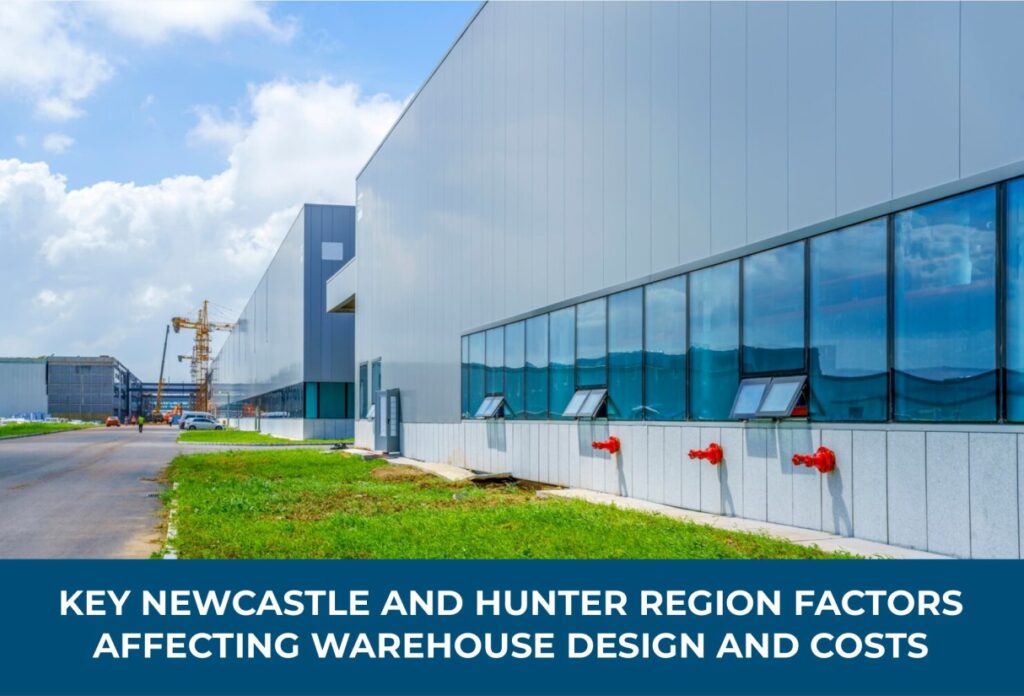
Building a warehouse in the Newcastle and Hunter Region is not the same as building anywhere else in NSW.
The logistics and freight sector in the Hunter Region has grown significantly with the expansion of Port of Newcastle operations. Warehouse specifications that met requirements five years ago may not meet current tenant expectations: B-double access, high bay eaves, and sealed hardstand are now baseline expectations for most industrial tenants.
The Hunter Region’s industrial land varies significantly in infrastructure readiness: some precincts have fully serviced lots with power, water, and sewer; others require significant infrastructure headworks (connection to mains services) that must be budgeted and programmed.
Flood overlays apply to parts of the Hunter River floodplain, affecting floor level requirements and potentially triggering additional development contributions.
Council infrastructure contribution levies for industrial development in the Newcastle LGA and Maitland LGA are high costs that must be included in the project budget from the outset.
Every warehouse that works efficiently makes the same choice early: it was designed around the operation, not the other way around.
Conclusion
A warehouse build in Newcastle is a long-term decision. The building you construct today will shape how your operation runs for the next 20 to 30 years. Getting the column grid right. Specifying adequate eave height. Designing loading docks for your actual vehicle mix. Specifying the floor for your actual loads.
These decisions are made once, during the design stage. Changing them after construction is expensive. Not changing them when they are wrong is more expensive still.
The right warehouse builder asks the right questions before drawing a single line. And then builds a facility that performs from day one.
AJA Commercial Building specialises in warehouse construction across Newcastle, the Hunter Valley, Maitland, Port Stephens, and the Central Coast. The team manages design, approvals, and construction on a single contract, with the operational questions asked at the start, not discovered at the end.