Most industrial builds in Newcastle do not run over budget due to construction costs.
They run over budget because of decisions made before construction begins.
A site that looked normal turns out to have unexpected ground conditions. A design finalised without builder input requires costly structural changes after DA approval. Materials with long lead times are ordered late, extending the programme by months.
None of these problems is invisible. They are all predictable. And a builder who is involved early enough can flag every one of them before they become costly.
The most expensive part of an industrial build is rarely the construction. It is the correction.
If you are planning an industrial facility in Newcastle (a factory, warehouse, distribution centre, or manufacturing building), this guide covers the five decisions that most commonly push industrial projects over budget and over programme.
Understanding them before you brief a builder will save you significant time and money.
Why Industrial Build Budgets in Newcastle Go Over Without Warning
Before the first shovel hits the ground, certain decisions, or oversights, can quietly push costs higher. Here are the five most common issues we see in Newcastle industrial projects and how to prevent them.
Engaging the Builder After the Design Is Already Finalised
This is the single most common cause of cost overruns on industrial projects.
The sequence goes like this: the client engages an architect or draftsperson; the design is developed; a DA (Development Application) is prepared for lodgement with council; and then a builder is brought in to price the job.
The problem is that the builder then finds issues the design did not account for: structural specifications that exceed what the site can support economically, loading dock configurations that will not work for the vehicles the client actually operates. Power supply requirements that the design assumes are available, but are not.
Each of these issues requires a design amendment. Each amendment requires consultants, time, and sometimes a revised DA. The project has not started, and it is already running late.
A manufacturing business in the Hunter Region proceeded through a full design process before engaging a builder. When the builder was brought in to price the job, significant issues emerged: the column grid did not allow for the overhead crane the client needed, the hardstand layout was insufficient for B-double truck access, and the electrical specification assumed a three-phase connection that was not available at the street without a supply upgrade. All three were fixable. None were cheap to fix at that stage.
The solution is simple: engage a builder during the design process, not after it. A design and construct model, where one team is responsible for both design and construction, eliminates this problem entirely, because the people who will build the facility are shaping the design from the start.Late builder engagement is the most visible. The next one is less obvious, but it shows up on almost every Newcastle industrial project.
Underestimating the Approval Timeline
DA approval timelines in the Newcastle and Hunter Region vary considerably depending on the local council, the land use classification, and the complexity of the proposal. For clear industrial developments on properly zoned land, DA approval can take a range of time. For more complex proposals (those requiring traffic impact assessments, environmental studies, acoustic reports, or heritage consideration), the timeline extends significantly.
The mistake is building a project programme that assumes DA approval in the optimistic range, without accounting for the realistic range.
- Newcastle City Council and Lake Macquarie City Council have different assessment processes and different workloads at different times of the year.
- Industrial land in some parts of the Hunter Region carries planning controls that require additional specialist reports: hydraulic assessment, contamination assessment, acoustic modelling.
- A Response to Submissions (RTS) from council, where the applicant must respond to objections or council queries, can add further time to the approval timeline.
A builder experienced in the specific councils that cover your site can give you a realistic approval timeline before you brief the design team, and can manage the DA process on your behalf to keep it moving as efficiently as possible.
Approval timelines are manageable when planned for. The third issue is structural, and it is often the most expensive surprise of all.
Not Accounting for Site-Specific Ground Conditions
Industrial land in the Newcastle and Hunter Region spans a wide range of geotechnical conditions (relating to the physical properties of the ground and soil). Parts of the region sit on rock close to the surface: good for bearing capacity, but expensive to excavate for services. Other areas have reactive or soft soils that require engineered foundations. Some sites near the Hunter River or coastal precincts have fill or contamination that affects both cost and programme.
A geotechnical investigation (soil and ground testing to determine bearing capacity and foundation requirements) is essential before finalising any industrial building design. Without it, the structural engineer is designing foundations on assumptions, and those assumptions can be significantly wrong.
A small factory development in the Maitland area proceeded to DA with a standard slab-on-ground specification based on assumed soil conditions. When the geotechnical report was commissioned (later than recommended), the soil was found to be highly reactive clay, soil that swells and shrinks significantly with moisture changes. The slab specification required a complete redesign to a waffle pod system (a suspended slab that isolates the building from ground movement), adding a significant amount to the foundation cost. This was not in the original budget.
Commission the geotechnical investigation early, ideally before the design is developed, not after. The cost depends on the site. The savings when it identifies an issue before the design is finalised are almost always multiples of that figure.
Specifying the Wrong Structural System for Use
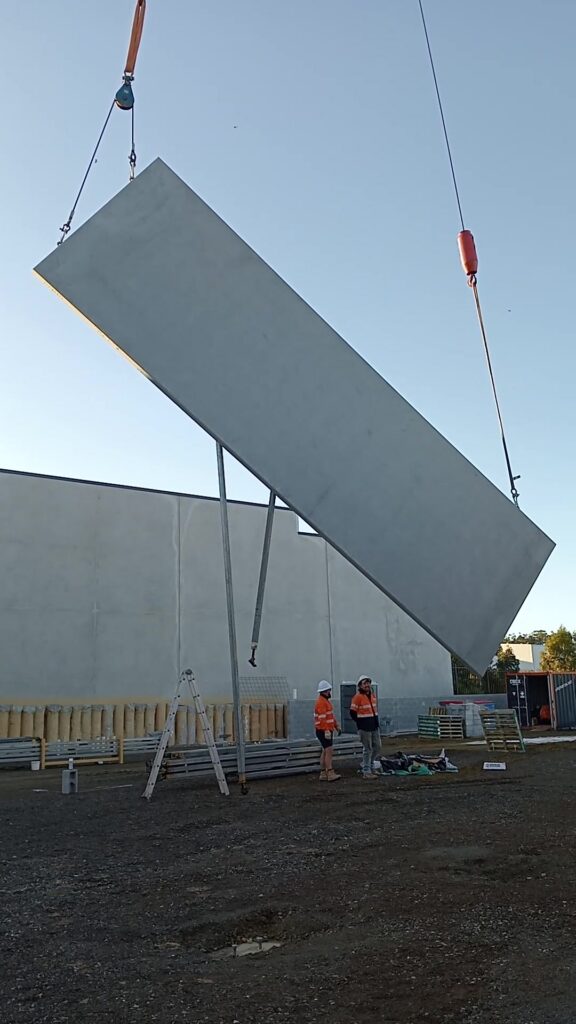
There are several main structural systems used for industrial buildings in the Newcastle region: steel portal frame, precast tilt panel (concrete panels cast flat on-site and tilted into position), and a hybrid of both. Each has a different cost profile, a different construction programme, and different implications for the building’s long-term flexibility.
| Structural System | Best For | Relative Cost | Key Consideration |
| Steel portal frame | Flexible spans, complex roof profiles, mezzanines, extensions | Mid | Faster to erect; more flexible for future modifications |
| Precast tilt panel | Large warehouse footprints, high fire resistance requirements, security-critical uses | Mid to high | Faster wall construction at scale; heavier foundation requirements |
| Hybrid (steel + precast) | Large industrial developments combining warehousing and manufacturing | Higher | Best of both systems; more complex to coordinate |
The wrong structural system for the use creates problems that last for the life of the building. A portal frame building that later needs to be divided for multi-tenancy is more complex to partition than a tilt panel structure. A tilt panel building on soft ground requires more expensive foundations than the equivalent portal frame.
A builder involved at the design stage will advise on the structural system that best fits the specific use, site, and budget, not the one they are most comfortable building.
Structural system chosen correctly upfront; that is, cost certainty at the foundation level. But the final issue affects projects that have done everything else right.
Underspecifying Power and Services Infrastructure
Industrial buildings have significant power requirements. Manufacturing facilities may need substantial three-phase power. Warehouses with automated racking systems, refrigeration, or intensive lighting have demands well above a standard industrial connection.
The cost of upgrading electrical infrastructure after a building is complete (running additional conduit, upgrading the main switchboard, negotiating a new supply arrangement with the network operator) is significantly higher than specifying it correctly during construction.
The same principle applies to compressed air reticulation (pipework for compressed air throughout the facility), drainage for wash-down areas, gas supply for manufacturing processes, and telecommunications infrastructure. These services are inexpensive to install during the build and expensive to retrofit.
A light manufacturing business in the Hunter Valley built a new facility and specified a standard three-phase power supply, adequate for their current equipment. Over time, they added a second production line that required a higher-capacity supply. The upgrade required a new supply cable from the street, a main switchboard replacement, and a period of disruption to operations. The total cost was significant. Specifying the higher supply during construction would have cost far less.
Think beyond current requirements. A good industrial builder will ask the right questions about your operational plans for the years ahead and specify services infrastructure accordingly.
How the Design and Construct Model of Industrial Builder Newcastle Prevents
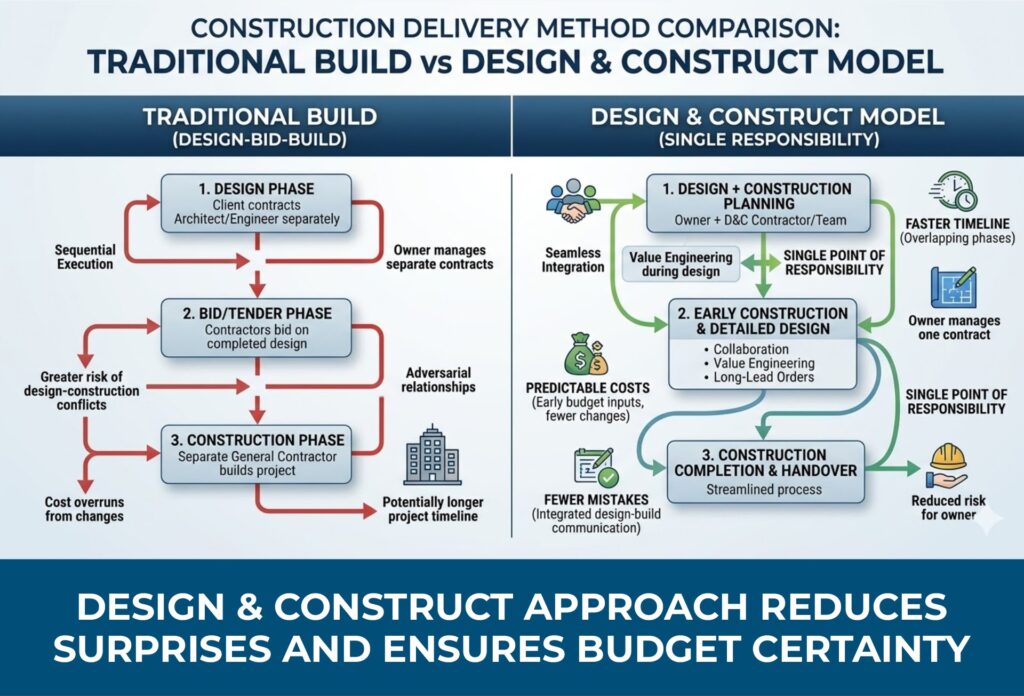
All five issues above are significantly less likely when a single team manages both the design and construction of the project.
In a design and construct model, the builder is responsible for the design meeting the brief, the design being buildable within the agreed budget, and the construction matching the design. There is no gap between what the designer specified and what the builder delivers, because they are the same party.
For industrial projects (where the complexity of site conditions, approvals, services, and operational requirements creates many opportunities for things to fall between the cracks), this matters.
The builder who asks about your operations before drawing a single line is more valuable than the builder who gives you the lowest quote after the design is done.
Conclusion
Industrial build budgets do not blow out randomly. They blow out at specific, predictable decision points, most of which occur before construction begins.
Late builder engagement. Optimistic approval timelines. Unknown ground conditions. Wrong structural system. Underspecified services. Each one is preventable with the right process and the right builder involved at the right time.
AJA Commercial Building delivers industrial construction across Newcastle, Lake Macquarie, Maitland, the Hunter Valley, Port Stephens, and the Central Coast. The team manages everything from initial site assessment through DA approval, construction, and handover, on a single contract with a single point of accountability.