Commercial construction on the Central Coast is accelerating at a pace that developers and business owners simply cannot afford to ignore. From Gosford to Tuggerah and across the Wyong corridor, new industrial sheds, retail spaces, office buildings, and mixed-use developments are reshaping this region’s economic landscape. Whether you are planning your first commercial building project or scaling an existing portfolio, understanding how construction here actually works will save you time, money, and significant frustration.
This guide cuts through the noise. It covers real costs, approval timelines, builder selection, and what separates a project that delivers from one that drags on for years.
WHY THE CENTRAL COAST IS A COMMERCIAL CONSTRUCTION HOTSPOT
The Central Coast sits between Sydney and Newcastle. That geography alone creates significant commercial and investment value. With major road infrastructure along the M1 Pacific Motorway and regular rail connections, it attracts businesses that need affordable land without sacrificing access to major markets.
Population growth here is consistent. The region’s population exceeded 340,000 residents, making it one of NSW’s largest urban centres. This growth fuels demand for warehousing, logistics hubs, retail tenancies, and office space. Developers across Central Coast and Newcastle are responding with new commercial and industrial estate developments.
Gosford continues to lead as the commercial core. Meanwhile, Tuggerah and Somersby industrial precincts attract manufacturers, distributors, and trade businesses. This spread creates multiple entry points for commercial property development across different price brackets and use cases.
Beyond geography, the economics work. Land values on the Central Coast remain lower than Sydney’s metropolitan fringe. Construction costs are competitive. Rental yields in commercial and industrial sectors have maintained strong performance as supply struggles to keep pace with demand.
COMMON TYPES OF COMMERCIAL PROJECTS IN THIS REGION
Not all commercial construction is the same. The Central Coast market supports a diverse mix of building types. Understanding which category your project falls into shapes everything from your DA pathway to your construction timeline.
Warehouses and Industrial Sheds
Industrial sheds and warehouses dominate the Somersby, Tuggerah, and Berkeley Vale precincts. Demand comes from e-commerce logistics, trade services, manufacturing, and storage. These builds typically offer the fastest approval pathways and the most predictable construction timelines.
Retail Construction
Retail construction on the Central Coast ranges from small tenancy fit-outs to full neighbourhood shopping strips. Coastal townships and growth suburbs like Woy Woy, Gosford, and Erina attract retail investment as population density increases.
Office Buildings
Gosford remains the primary hub for professional and government offices. Smaller commercial suites and owner-occupied office buildings are also growing across suburban Central Coast locations. Many business owners prefer owning over leasing, driving demand for custom office construction.
Mixed-Use Developments
Ground-floor retail with upper-floor offices or residential tenancies is an increasingly common model here. These projects require careful planning and zoning verification but offer multiple income streams from a single site.
| Building Type | Common Precincts | Typical Use | Approval Pathway |
|---|---|---|---|
| Warehouse / Industrial Shed | Somersby, Tuggerah, Berkeley Vale | Storage, logistics, manufacturing | CDC or DA |
| Office Building | Gosford, Wyong, Erina | Professional services, government | DA |
| Retail Construction | Gosford, Erina, Woy Woy | Shops, showrooms, service retail | DA or CDC |
| Mixed-Use Development | Gosford CBD and surrounds | Retail + office or residential | DA |
| Precast Panel Buildings | Industrial precincts across region | Rapid commercial build, industrial | DA or CDC |
UNDERSTANDING COMMERCIAL CONSTRUCTION COSTS IN NSW
Cost clarity is the number one concern for any developer or business owner starting a commercial building project. Vague estimates lead to budget blowouts. Specific knowledge keeps projects financially viable from day one.
Commercial construction cost per square metre in NSW varies widely based on building type, specification, and location. The table below references indicative ranges drawn from published industry sources.
Verified Cost Reference – Rawlinsons Australian Construction Handbook 2024
Indicative commercial construction costs in NSW: Industrial/warehouse sheds from approx. $900 to $1,800/m2. Commercial office buildings from approx. $2,200 to $4,500+/m2. Retail construction from approx. $1,500 to $3,000/m2. These are base build figures and exclude land, DA fees, fitout, and professional fees.
| Building Category | Indicative Cost Range (NSW, 2024) | Key Variables |
|---|---|---|
| Industrial Shed / Warehouse | $900 – $1,800 per m2 | Portal frame vs precast, span, height, site works |
| Commercial Office (Low Rise) | $2,200 – $3,500 per m2 | Fitout level, facade, services complexity |
| Commercial Office (Multi-Storey) | $3,500 – $4,500+ per m2 | Structure type, floor count, lift, HVAC |
| Retail Construction | $1,500 – $3,000 per m2 | Tenancy type, glazing, services, carpark |
| Precast Panel Buildings | $1,200 – $2,000 per m2 | Panel complexity, insulation spec, height |
These figures represent base construction only. Your total project cost will also include land acquisition, geotechnical testing, DA and CC application fees, surveying, architectural and engineering fees, landscaping, and fitout. Budgeting for 15 to 25 percent above the base build cost is a prudent planning position.
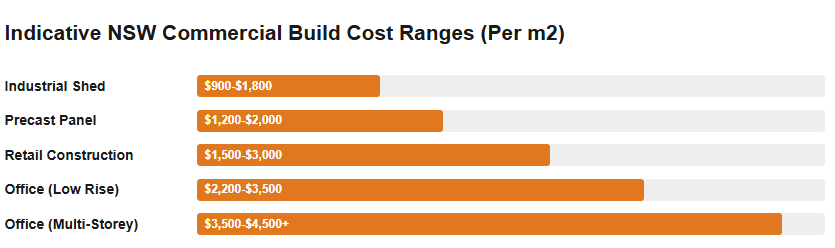
Source: Rawlinsons Australian Construction Handbook 2024. Indicative NSW figures only. Obtain project-specific quotes for accuracy.
One approach that directly addresses cost blowouts is design and construct delivery. When your builder designs within a fixed budget from the start, you avoid the tender shock that hits so many developers after committing to an architect-led design.
NAVIGATING THE DA AND APPROVAL PROCESS ON THE CENTRAL COAST
The Central Coast Council DA process is the single most common source of delays in commercial building projects. Understanding how it works gives you a significant planning advantage.
Most commercial construction projects on the Central Coast require either a Development Application or a Complying Development Certificate. The right pathway depends on your site zoning, proposed use, and whether your project meets the criteria under the State Environmental Planning Policy (Exempt and Complying Development Codes) 2008.
Verified Fact – NSW Government Planning Portal
Under the Environmental Planning and Assessment Act 1979 (NSW), all development must be assessed against relevant environmental planning instruments. The NSW Planning Portal at planningportal.nsw.gov.au is the official gateway for DA lodgement, tracking, and certification applications across all NSW councils including Central Coast Council.
Development Application (DA)
A DA is required for most new commercial buildings, significant alterations, and change-of-use applications. You submit it to Central Coast Council along with plans, supporting reports, and application fees. The council then assesses the application against local environmental plans, the Central Coast Development Control Plan, and any relevant state policies.
Complex DAs often require traffic impact statements, acoustic reports, stormwater management plans, and heritage assessments depending on the site. Preparation time matters enormously here. Incomplete or poorly documented applications cause requisitions and add months to the process.
Complying Development Certificate (CDC)
A CDC is a faster alternative for projects that meet strict pre-determined criteria. An accredited certifier can approve eligible commercial projects without a full DA. Approval can arrive in as little as 10 business days for qualifying applications. Not all commercial sites or project types are eligible, however.
Construction Certificate and Occupation Certificate
After DA or CDC approval, you need a Construction Certificate before works begin. Finally, an Occupation Certificate confirms the building complies with its approval conditions before you can legally use or occupy it. Both are mandatory steps under NSW building legislation.
| Approval Stage | Purpose | Typical Timeframe | Who Issues It |
|---|---|---|---|
| Development Application (DA) | Assess development against planning rules | 3 to 9+ months | Central Coast Council |
| Complying Development Certificate (CDC) | Fast-track approval for eligible projects | 10 to 20 business days | Accredited private certifier |
| Construction Certificate (CC) | Approve construction plans and specs | 2 to 6 weeks | Council or accredited certifier |
| Occupation Certificate (OC) | Confirm building is safe and compliant | Issued at practical completion | Council or accredited certifier |
WHY DESIGN AND CONSTRUCT WORKS FOR CENTRAL COAST PROJECTS
The traditional model separates design from construction. You engage an architect first, finalise a design, then go to tender. That process creates a dangerous gap. By the time tenders come back, costs often exceed the budget significantly. This is called tender shock, and it derails more commercial projects than most developers expect.
Design and construct eliminates that gap entirely. One contractor handles both stages. Design happens within a defined budget from day one. There is no late-stage price surprise, because the person designing it is also the person building it.
Three Core Benefits of the Design and Construct Approach
- Cost Certainty: You know the price before construction begins. The builder designs within your budget, not beyond it.
- Programme Confidence: One team manages all stages. Fewer handovers mean fewer delays.
- Quality Accountability: The builder owns the outcome from concept to completion. There is no finger-pointing between architect and contractor.
For developers and business owners on the Central Coast, design and construct is particularly well suited to industrial sheds, warehouses, office builds, and precast panel projects. These building types have well-established design parameters that allow accurate pricing early.
“AJA Commercial Construction were exceptional at building our rural warehouses. Their workmanship was top tier, communication was excellent and they always took the time to answer every question along the way. Highly professional from start to finish. We won’t hesitate to use them again.”
– Madeline Garling
Explore how AJA Commercial Building delivers the design and construct process for commercial projects across the Central Coast and surrounding regions.
INDUSTRIAL CONSTRUCTION ACROSS THE CENTRAL COAST
Industrial construction makes up a significant portion of the commercial building activity on the Central Coast. The region’s industrial precincts continue attracting trade businesses, manufacturers, and logistics operators who need purpose-built space.
The Somersby Industrial Estate, Tuggerah Business Park, and the Berkeley Vale precinct all offer zoned industrial land with good access to the M1. These locations suit portal frame steel sheds, precast concrete tilt-up buildings, and hybrid structural systems depending on span requirements and budget.
Portal Frame Steel Sheds vs. Precast Panel Construction
Portal frame steel is the most common structural system for industrial sheds on the Central Coast. It delivers large clear-span interiors, fast construction, and flexible layout options. Precast panel construction, on the other hand, offers superior thermal performance, fire resistance, and acoustic properties. It suits operations requiring temperature control, secure storage, or sound insulation.
Verified Fact – Standards Australia
Precast concrete panel construction in Australia must comply with AS 3600-2018 (Concrete Structures) and relevant structural design standards. Precast systems are subject to engineering certification requirements under the National Construction Code (NCC) 2022.
AJA Commercial Building specialises in industrial construction across the Central Coast, including portal frame and precast panel solutions for warehouses, manufacturing facilities, and commercial sheds. Their team covers the full delivery from design through to occupation.
HOW TO CHOOSE A LICENSED COMMERCIAL BUILDER ON THE CENTRAL COAST
Selecting the right contractor is the most consequential decision in any commercial building project. The wrong choice leads to delays, defects, legal disputes, and costs that far exceed the original budget.
The first step is licence verification. Commercial builders in NSW must hold an unrestricted contractor licence issued by NSW Fair Trading. You can check any builder’s licence status online through the NSW Fair Trading Licence Register. Do not engage any contractor without verifying their licence class first.
Beyond the Licence: What Else to Check
- Commercial experience: Ask for completed project examples in the same building category as yours.
- Local knowledge: A builder with Central Coast and Hunter Valley project history understands council processes and local subcontractor networks.
- Insurance: Verify public liability and contract works insurance before signing anything.
- References: Speak to previous clients, not just read testimonials. Ask about programme, communication, and defect management.
- Contract clarity: Ensure the contract includes a fixed price, detailed scope, payment schedule, and programme milestone dates.
AJA Commercial Building holds the appropriate licensing for commercial construction across the Central Coast and surrounding regions. They operate transparently, providing detailed proposals and fixed pricing before any commitment is made.
REALISTIC CONSTRUCTION TIMELINES FOR COMMERCIAL PROJECTS
One of the most common frustrations in commercial construction is misaligned timeline expectations. Developers plan for six months and find themselves at eighteen months without a completed building. Understanding what drives each phase prevents that outcome.
Phase 1 – Pre-Construction and Approvals
This is typically the longest phase. It includes site due diligence, design development, DA or CDC preparation, and council assessment. For a standard commercial industrial shed on a clean site with a CDC pathway, this can take as little as 8 to 14 weeks. A full DA for a larger commercial development on a complex site can take 6 to 12 months or longer.
Phase 2 – Procurement and Mobilisation
After approval, your builder procures structural steel, panels, or other long-lead materials. Procurement for portal frame sheds typically takes 8 to 14 weeks. Precast panel systems may require 12 to 20 weeks for fabrication. Planning this phase in parallel with DA assessment reduces overall project duration.
Phase 3 – Construction
A straightforward industrial shed of 500 to 1,000 m2 may be built in 10 to 16 weeks on site. A larger office or retail development of 2,000 m2 or more typically requires 20 to 40 weeks of construction time. Complexity, trades sequencing, and weather all influence the programme.
| Project Type | Pre-Construction | Construction | Total Indicative Duration |
|---|---|---|---|
| Industrial Shed (CDC pathway) | 8 to 14 weeks | 10 to 16 weeks | 18 to 30 weeks |
| Warehouse (DA pathway) | 16 to 36 weeks | 14 to 22 weeks | 30 to 58 weeks |
| Commercial Office | 20 to 40 weeks | 20 to 40 weeks | 40 to 80 weeks |
| Retail Development | 16 to 36 weeks | 18 to 30 weeks | 34 to 66 weeks |
These are indicative ranges. Your actual timeline depends on site conditions, project complexity, council workload, and contractor resourcing. A design and construct delivery model compresses overall duration by overlapping design and procurement phases effectively.
MANAGING RISK BEFORE YOU BREAK GROUND
Commercial construction carries real financial risk. Most of that risk, however, is manageable with the right preparation. Here is where the problems typically start and how to avoid them.
Cost Blowouts
The most common risk. Cost blowouts happen when the design phase is disconnected from budget reality. Architects often design without firm cost control. By the time tenders come back, costs exceed budget by 20 to 40 percent. The solution is to lock in a fixed-price contract with a design and construct contractor who works within your budget from the outset.
Approval Delays
DA delays on the Central Coast are real. They often stem from incomplete applications, missing reports, or zoning conflicts that could have been identified earlier. Engage a planning consultant before lodging. Submit complete, well-documented applications the first time.
Scope Creep
Changes to the scope of work during construction are the fastest way to blow a budget. Define the scope in writing before construction starts. Any variation must be documented and priced before the work proceeds. A clear contract protects both parties.
Contractor Insolvency
In Australia, contractor insolvency during a build is not uncommon. Protect yourself by checking the builder’s financial standing, verifying their insurance, and using progress payments tied to certified milestone completions rather than time-based schedules.
Site Conditions
Hidden site conditions — poor soil bearing capacity, contamination, underground services — can significantly increase costs. Commission a geotechnical report before finalising your budget. Many Central Coast sites near former industrial areas or coastal zones carry specific geotechnical risk.
FREQUENTLY ASKED QUESTIONS
What types of commercial construction projects are most common on the Central Coast?
Warehouses, industrial sheds, retail centres, and office buildings are the most common builds. Growth corridors around Gosford, Tuggerah, and Somersby drive consistent demand for industrial and commercial space.
How much does commercial construction cost per square metre in NSW in 2025?
Industrial sheds typically range from $900 to $1,800/m2. Commercial offices range from $2,200 to $4,500+ per m2. Retail construction falls between $1,500 and $3,000/m2. These are base build figures only and exclude DA fees, fitout, and professional costs. Source: Rawlinsons Australian Construction Handbook 2024.
What council approvals do I need for commercial construction on the Central Coast?
Most projects need either a DA submitted to Central Coast Council or a CDC through an accredited certifier. You will also need a Construction Certificate before building starts and an Occupation Certificate before occupying the building.
What is design and construct, and is it better for commercial projects in NSW?
Design and construct means one contractor handles both design and building. It delivers cost certainty, faster programmes, and single-point accountability. For most commercial projects on the Central Coast, it significantly reduces cost blowout risk.
How do I know if a commercial construction company is properly licensed in NSW?
Check the NSW Fair Trading Licence Register online. Commercial builders must hold an unrestricted contractor licence. Always verify before signing a contract.
What is the difference between commercial construction and industrial construction in NSW?
Commercial construction covers offices, retail, and mixed-use buildings. Industrial construction covers warehouses, factories, and storage facilities. Both require licensed contractors and appropriate council or certifier approval.
Can a residential builder legally do commercial construction work in NSW?
No. Commercial construction in NSW requires an unrestricted contractor licence from NSW Fair Trading. A residential builder licence does not cover commercial work. Always confirm the correct licence class before engaging any contractor.
What are the biggest risks in commercial construction projects and how do I avoid them?
The biggest risks are cost blowouts, DA delays, scope creep, and poor contractor selection. Mitigate these by using a fixed-price design and construct contract, engaging a town planner early, completing geotechnical testing before budgeting, and verifying your builder’s licence and insurance.
Is the Central Coast a good area to invest in commercial property development in 2025?
Yes. Population growth, infrastructure investment, competitive land values relative to Sydney, and strong industrial demand make the Central Coast a compelling market for commercial property development in 2025.
How long does the DA process take for commercial construction on the Central Coast?
Simple projects with a CDC pathway can achieve approval in 10 to 20 business days. Full DA assessments for commercial projects at Central Coast Council typically take 3 to 9 months depending on complexity and documentation quality. Engaging a town planner reduces delays significantly.
Do I need a project manager for a commercial construction project?
With a design and construct contractor, project management is typically included. With a traditional model, you will usually need a separate superintendent or project manager to coordinate trades, approvals, and programme milestones.
What is a Complying Development Certificate and when can I use it?
A CDC is a fast-track approval available for projects that meet pre-set standards under the NSW State Environmental Planning Policy (Exempt and Complying Development Codes) 2008. Eligible commercial projects can receive approval in as little as 10 business days without going through a full DA. Not all sites and uses are eligible.
What is the National Construction Code and does it apply to my project?
Yes. The National Construction Code (NCC) 2022 sets minimum performance requirements for all buildings in Australia, including structural integrity, fire safety, energy efficiency, and accessibility. All commercial buildings must comply with the NCC regardless of size or location.
How do I compare commercial builder quotes fairly?
Ensure every quote is based on the same scope of work. Compare inclusions, exclusions, contract type, payment schedule, and programme milestones. The cheapest tender is rarely the best value. Look for transparency, fixed pricing, and demonstrated experience in your building type.
MAKING YOUR COMMERCIAL PROJECT HAPPEN ON THE CENTRAL COAST
Commercial construction on the Central Coast offers genuine opportunity. The region’s growth, its diverse precincts, and its improving infrastructure create the right conditions for industrial, retail, and office investment. However, opportunity only converts to a successful project with the right information, the right contractor, and the right approach to approvals and cost planning.
The key takeaways from this guide are straightforward. Know your building type and its approval pathway. Budget realistically using verified cost benchmarks. Start the DA process earlier than you think necessary. Choose a licensed commercial contractor with proven local experience. And consider design and construct delivery as your default model for cost certainty and programme confidence.
AJA Commercial Building works with developers, business owners, and investors across the Central Coast, Hunter Valley, Newcastle, Lake Macquarie, Maitland, Port Stephens, and the Mid North Coast. Their team delivers commercial construction, industrial construction, design and construct, office builds, warehouse construction, and precast panel projects with fixed pricing and genuine accountability from start to finish.