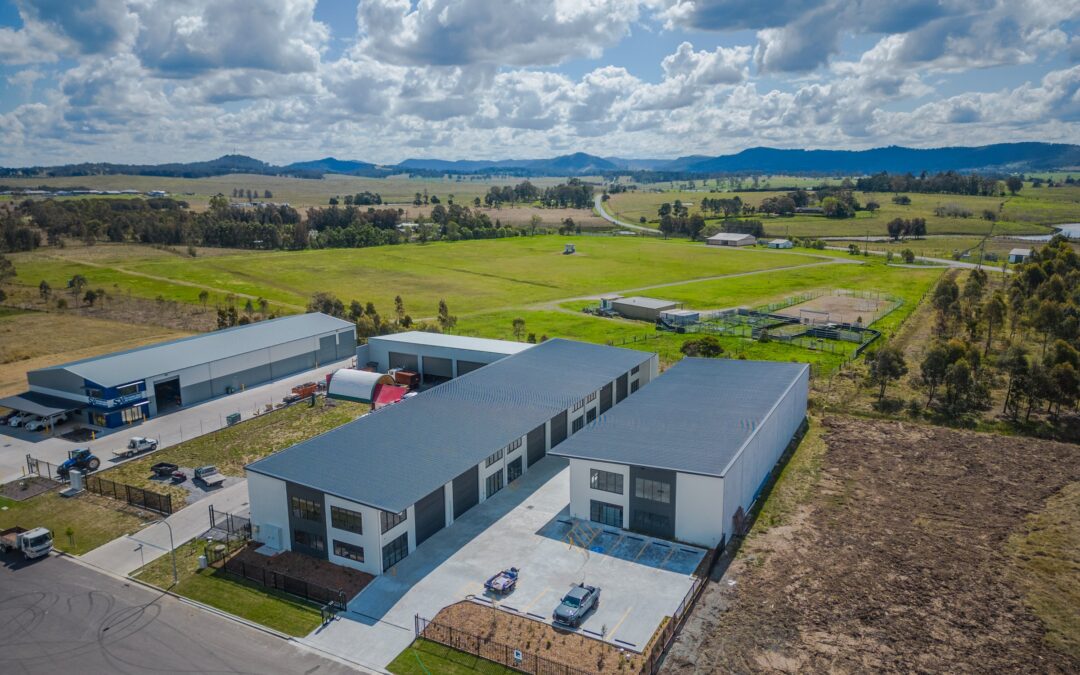
Planning an industrial project in Maitland? This guide covers practical decisions for warehouses, factories, offices and other commercial facilities across the Hunter.
What Does an Industrial Builder in Maitland Actually Do?
The term “industrial builder” covers a broad spectrum of construction disciplines, and it’s worth understanding exactly what distinguishes a specialist industrial contractor from a general commercial builder, particularly in the Newcastle and Hunter Valley market.
A qualified industrial builder manages the full construction lifecycle of structures designed for manufacturing, warehousing, logistics, processing, and heavy commercial use. This includes tilt-up concrete panel construction, structural steel fabrication and erection, large-span portal frame buildings, specialised concrete slabs engineered for heavy dynamic loads, fit-out of industrial interiors including mezzanines and racking systems, and coordination of essential services including three-phase power, industrial gas, compressed air, and stormwater infrastructure.
In the Hunter Region specifically, experienced industrial builders also navigate the local planning landscape (including Newcastle City Council, Maitland City Council, and Port Stephens Council development pathways) as well as state-significant development applications for larger industrial projects. The region’s industrial zones, including the well-established Beresfield, Tomago, and Rutherford industrial precincts, each carry specific infrastructure constraints and development controls that a locally experienced builder understands intimately.
Local Knowledge That Matters
Hunter Valley industrial sites often involve complex geotechnical conditions: reactive clays, filled ground near former mining operations, and flood-liable land along floodplain corridors near the Hunter River. An experienced local industrial builder will identify these risks during the feasibility stage, not after footings are poured.
Types of Industrial and Commercial Buildings Most Common in the Hunter Region
The Hunter Valley and broader Newcastle region has one of the most diverse industrial and commercial property markets in regional New South Wales. Understanding the most common building typologies helps you clarify what your project actually requires.
Warehouse & Distribution Facilities
High-bay racking-compatible warehouses with wide-span clear floors, heavy-duty concrete slabs, dock-leveller loading bays, and container-height roller doors. Increasingly in demand across Beresfield, Tomago, and the developing Maitland industrial corridor.
Manufacturing & Processing Plants
Purpose-designed structures accommodating heavy machinery, overhead cranes, explosion-rated electrical systems, specialised flooring, and bespoke ventilation. Common across the Hunter’s food processing, mining services, and resource sector supply chains.
Commercial Office & Business Premises
From standalone office buildings in Newcastle CBD fringe locations to campus-style commercial developments and integrated office/warehouse facilities across Port Stephens and the Central Coast growth corridors.
Multi-Tenancy Industrial Complexes
Strata-titled industrial unit developments that house multiple businesses in efficiently designed, individually accessed bays. High demand currently exists across Rutherford, Thornton, and Tuggerah on the Central Coast.
Industrial Building Compliance: What the Codes Actually Require in NSW
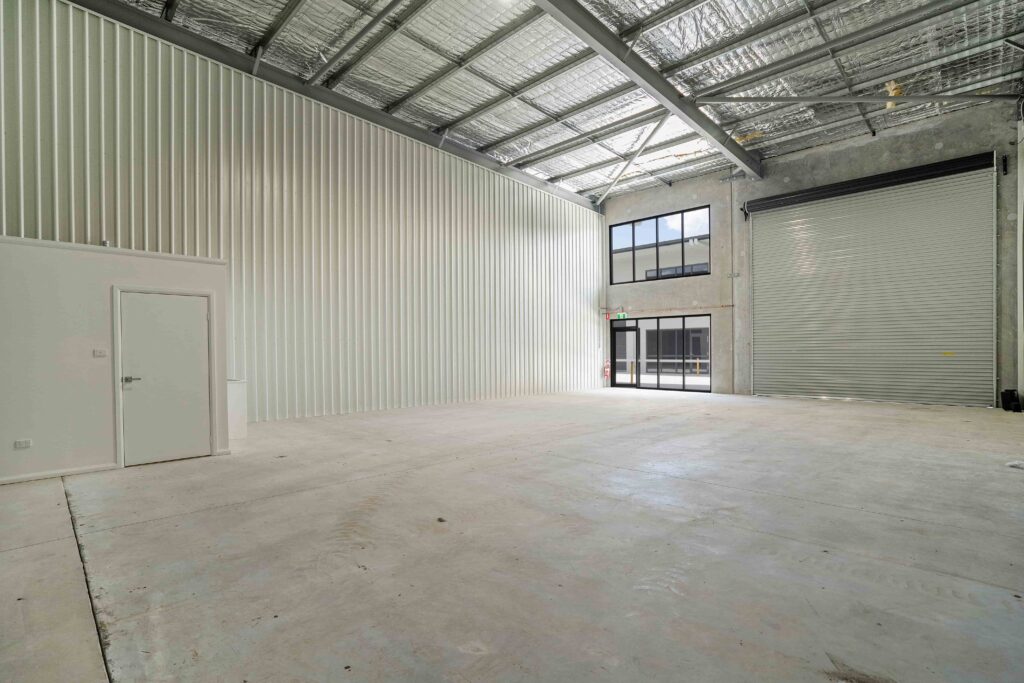
Industrial and commercial construction in Newcastle, Maitland, and across the Hunter Valley is governed by a layered framework of national, state, and local requirements. Understanding these layers protects you from costly non-compliance and ensures your facility operates legally from day one.
The National Construction Code (NCC) 2022
The National Construction Code 2022, published by the Australian Building Codes Board (ABCB), is the primary technical standard for all construction in Australia. Industrial buildings typically fall under Class 7 or Class 8 of the NCC classification system. Class 7b applies to buildings used for storage, including warehouses. Class 8 applies to buildings used for production, assembling, altering, repairing, packing, finishing, or cleaning of goods.
The NCC specifies minimum requirements for structural integrity, fire resistance levels (FRL), fire detection and suppression systems, essential services, energy efficiency, and accessibility. For industrial buildings in NSW, Part J energy efficiency provisions and the Disability (Access to Premises: Buildings) Standards 2010 must be met for the public-facing portions of any commercial or industrial facility.
Relevant Australian Standards
- AS 4100:2020: Steel structures (applicable to the majority of Hunter Valley industrial buildings using portal frames or structural steel)
- AS 3600:2018: Concrete structures (governs tilt-up panels, footings, slabs, and reinforced concrete elements)
- AS 1170 Series: Structural loading standards including wind actions and earthquake loads
- AS 2118: Automatic fire sprinkler systems (required for warehouses exceeding floor area thresholds under the NCC)
- AS 3000: Wiring rules for all electrical installations on industrial sites
Local Planning Controls: Hunter Region
Each council area across the Hunter Region operates its own Local Environmental Plan (LEP) and Development Control Plan (DCP). Newcastle’s Newcastle Local Environmental Plan 2012, Maitland’s Maitland Local Environmental Plan 2011, and Port Stephens’ Port Stephens Local Environmental Plan 2013 each contain specific zoning tables, building envelopes, setbacks, car parking ratios, and land use permissibility that directly shape what you can build and where.
Industrial land in the Hunter Region is predominantly zoned IN1 General Industrial or IN2 Light Industrial under the relevant LEP. Some strategic employment zones in the Maitland and Central Coast council areas carry E4 General Industrial classification under the post-2022 Standard Instrument. Your builder’s familiarity with the operative zone and its development controls is non-negotiable.
Flood & Contamination Overlays
Significant portions of the Hunter Valley’s industrial land (particularly near the Hunter River, Paterson River, and the Williams River floodplains) sit within flood risk management overlays. Development on flood-liable industrial land typically requires a flood risk assessment and may impose minimum finished floor level (FFL) requirements of 500mm or more above the 1-in-100-year flood level. Former mining, industrial, and agricultural sites may also carry contamination records requiring a remediation action plan (RAP) before a DA can be approved.
Tilt-Up Concrete vs Steel Frame: Which Is Right for Your Industrial Build?
The two most widely used structural systems for industrial construction in the Newcastle and Hunter Valley region are tilt-up concrete panel construction and structural steel portal frame construction. Both have genuine strengths, and the right choice depends on your specific operational brief, site conditions, and programme.
Tilt-Up Concrete Panels
Cast on-site and tilted into position by mobile cranes, tilt-up panels offer excellent thermal mass, outstanding fire resistance, low ongoing maintenance, and a clean exterior aesthetic. Particularly well-suited to facilities where product protection from temperature variation matters. Standard panel heights range from 6m to 14m+, accommodating high-bay storage requirements common in distribution centres servicing the Hunter corridor.
Structural Steel Portal Frames
Portal frame construction delivers large clear-span interior spaces, typically 18m to 40m+, with faster erection times than concrete alternatives. Steel accommodates overhead crane rail systems readily and is the standard choice for manufacturing facilities where clear floor area and ceiling height are paramount. Galvanised Colorbond roof and wall cladding systems are routinely paired with steel frames for the Hunter’s diverse climate conditions.
Many contemporary industrial builds in the Hunter Valley use a hybrid approach: tilt-up concrete panels for the building envelope walls combined with structural steel internal framing for spanning large roof areas. This combination captures the durability and low-maintenance characteristics of concrete exteriors while retaining the clear-span flexibility of structural steel internally.
Commercial Office Construction in Newcastle, Maitland, and the Hunter Region
Not every business enquiring about an industrial or commercial builder needs a warehouse. Significant demand across the Hunter Region continues for purpose-built commercial office facilities, particularly as the post-pandemic shift toward owner-occupied premises accelerates across Maitland’s growing commercial precincts and Newcastle’s inner west.
As an experienced office builder in Newcastle and across the Hunter Valley, quality commercial office construction demands a fundamentally different design and build approach from industrial facilities, but shares many of the same compliance and project management challenges.

What to Expect from a Quality Commercial Office Build
- Full design development from concept through to construction documentation and council submission
- Structural engineering coordination for multi-storey concrete or steel-framed office buildings
- Mechanical and electrical services design integration, including HVAC, data cabling, fire detection, and BMS
- Acoustic engineering compliance for open-plan and meeting room configurations
- Accessibility compliance under Disability (Access to Premises: Buildings) Standards 2010
- NCC Section J energy efficiency compliance, increasingly critical for commercial office buildings in 2026
- Post-construction defect liability management and practical completion handover
How to Choose the Right Industrial or Commercial Builder in the Hunter Valley
Selecting the wrong builder is the single most common and most avoidable cause of industrial construction projects going over budget, over time, or both. The Hunter Valley has no shortage of contractors willing to quote on industrial work, but the field of builders with genuine industrial construction experience, financial stability, and the subcontractor network to deliver quality outcomes is considerably narrower.
Key Selection Criteria for Industrial Projects
- Demonstrated industrial portfolio: Request photos, references, and contact details from completed industrial projects of comparable scale in the Hunter Region, Central Coast, or Port Stephens. Residential or small commercial experience does not translate to industrial capability.
- Subcontractor relationships: Industrial construction quality depends heavily on the builder’s subcontractor network: structural steel fabricators, concrete specialists, mechanical services contractors, and fire protection installers. Ask who they use and for how long.
- Financial stability: Subcontractor insolvency is the leading cause of stalled industrial construction projects in Australia. Request trade references and consider a performance bond for large contracts under the Security of Payment framework.
- Project management structure: Understand who your day-to-day contact is during construction. Experienced industrial builders assign a dedicated project manager or site supervisor to your project, not just a salesperson who hands off after contract signing.
- Industry body membership: Membership in the Master Builders Association NSW or the Housing Industry Association (HIA) signals a commitment to professional standards, continuing education, and ethical conduct.
- Insurance coverage: Confirm the builder holds current project-appropriate insurance and workers’ compensation cover.
Why Industrial and Commercial Construction in the Hunter Valley Requires Local Expertise
The Hunter Valley, Maitland, Port Stephens, and Central Coast represent one of Australia’s most economically significant regional corridors. The region’s industrial economy is increasingly diversified beyond its historical reliance on coal mining, encompassing advanced manufacturing, defence supply chains, agricultural processing, logistics and freight, healthcare infrastructure, and technology-enabled services.
This economic diversity drives sustained demand for purpose-built industrial and commercial facilities across the region, but it also means construction requirements are genuinely varied. A logistics facility at Beresfield has fundamentally different structural and services requirements from a food-grade processing plant in the Upper Hunter or a clean-room research facility in Newcastle’s technology precinct.
Climate and Site Conditions Specific to the Hunter Region
The Hunter Region’s climate presents specific construction design considerations that a non-local builder may underestimate. The coastal areas of Newcastle and Port Stephens fall within a C2 corrosivity zone under AS 3826, meaning structural steel, fixings, and cladding systems must be specified with appropriate surface treatments and coating systems to resist salt-laden coastal air. Buildings within 1km of the coast require particular attention to fastener specification and cladding sealing details.
Inland Hunter Valley sites experience a markedly different climate, with temperature extremes ranging from below 0°C in winter to above 40°C in summer, that affects insulation specification, concrete curing protocols, and HVAC system design for occupied industrial spaces. The Bureau of Meteorology’s climate data for the Hunter region confirms average summer maximums in Maitland and Cessnock regularly exceed 32°C, reinforcing the importance of thermal performance design for industrial buildings housing people and temperature-sensitive products.
Industrial Fit-Out in the Hunter Valley: Beyond the Shell Build
The structural shell of an industrial building is just the beginning. For most industrial operators, the fit-out of the interior, and the integration of operational infrastructure, represents at least as much complexity as the primary construction.
An experienced Industrial Builder in Maitland or the Hunter Valley will coordinate or directly deliver fit-out elements including:
- Epoxy or polyurethane industrial floor coatings engineered for chemical resistance, heavy forklift traffic, or hygienic food-grade requirements
- Mezzanine floor structures: structural steel or concrete, with appropriate fire rating where occupants are below
- Overhead crane and monorail infrastructure, including structural integration with the primary building frame
- Dock leveller and hydraulic loading dock systems
- High-speed roller doors and industrial sectional doors
- Industrial racking systems and materials handling infrastructure
- Three-phase switchboard design and distribution, including motor control centres for manufacturing plant
- Compressed air infrastructure: ring main distribution, compressor rooms, and tool drops
- Specialised ventilation and dust extraction systems for woodworking, metalworking, and chemical processing applications
Coordinating these fit-out elements through your primary builder, rather than managing separate contracts for each trade, significantly reduces coordination risk, clarifies liability, and compresses your overall commissioning timeline. Explore AJA Commercial Building’s full service range to understand how an integrated delivery approach works in practice.
Frequently Asked Questions About Industrial Construction in Newcastle & Hunter Valley
Industrial construction across the Hunter Region must comply with the National Construction Code (NCC) 2022, relevant Australian Standards (particularly AS 4100 for steel structures and AS 3600 for concrete), and local council LEP and DCP provisions. Flood overlay mapping, Bushfire Attack Level (BAL) ratings for rural-fringe sites, and contamination management frameworks may also apply depending on site location. The NCC classifies most warehouses as Class 7b and manufacturing buildings as Class 8, each with specific fire, structural, and energy efficiency requirements.
Most new industrial buildings require Development Approval (DA) from the relevant council, or a Complying Development Certificate (CDC) from a private certifier where the development meets the criteria under the applicable State Environmental Planning Policy. CDC pathways are generally available for straightforward industrial buildings on correctly zoned land that meet setback, height, and land use criteria without requiring variation. Complex sites, large footprint developments, or land with overlays will typically require a full DA.
Tilt-up concrete panels are cast on-site and tilted into position, offering excellent fire resistance, thermal mass, low maintenance, and strong security characteristics. They’re well-suited to temperature-sensitive storage and chemical facilities. Structural steel portal frames deliver faster erection speed, wider clear spans (18–40m+), easier future reconfiguration, and straightforward crane integration, making them the preferred choice for manufacturing and logistics facilities. Many Hunter Valley industrial projects use a hybrid approach, combining concrete panel exteriors with steel internal framing for the best of both systems.
Commercial and industrial construction in NSW is not subject to the same statutory warranty framework that applies to residential construction under the Home Building Act 1989. Warranties for industrial and commercial buildings are negotiated contractually. Industry best practice includes a 12-month defects liability period post-practical completion, with specific warranties for roofing, structural elements, waterproofing, and mechanical systems often running for 5–10 years depending on product specifications. Always review the defects liability period and the process for lodging defects before signing a construction contract.
Industrial concrete slabs for forklift-operating warehouses are engineered to the specific axle loads of the forklift fleet, racking point loads, and uniformly distributed loads from stored goods. Counterbalance forklifts with a 3-tonne capacity typically require a minimum 150mm–180mm reinforced slab with a compressive strength of 32–40 MPa and fibre reinforcement or conventional rebar. Narrow-aisle VNA forklifts impose significantly higher point loads requiring thicker, more heavily reinforced concrete. A geotechnical report is essential before slab design is finalised, particularly on reactive clay profiles common across parts of the Hunter Valley.
Why Local Industrial Expertise Makes the Difference in the Hunter Valley and Newcastle
The gap between a builder who has completed a few commercial projects and a genuinely experienced industrial contractor is not subtle; it shows up in the quality of your concrete, the accuracy of your programme, the reliability of your subcontractors, and the professionalism of your handover documentation.
For business owners investing in purpose-built industrial or commercial facilities across Newcastle, Maitland, Port Stephens, the Central Coast, and the broader Hunter Region, the right builder is not necessarily the cheapest tender; it’s the contractor who understands what your facility needs to do, who knows the local approval landscape, and who has the proven capability and relationships to deliver on time and to specification.
Ready to Start Your Industrial or Commercial Build?
Whether you’re planning a new warehouse in Beresfield, a commercial office in Newcastle, a manufacturing facility in Maitland, or an industrial complex on the Central Coast or Port Stephens, AJA Commercial Building brings the local expertise and delivery capability your project demands. Let’s talk about what you’re building.